No AI Policy
I do not use generative “AI”.
Why?
Large Language Models and Generative AI are anti-human technologies.
Enclosure of human knowledge and culture
The promotion of “AI” is an attempt to enclose the cultural commons.
The corporations that create these things scrape every scrap of information they can find, in many cases, destroying access to that information for others. This happens through the literal destruction of books and also by scraping sites so frequently and so carelessly that they are forced offline. An art project that I had online for more than a decade was being hit by scrapers so hard that it was making all of my other websites unresponsive. Many other sites have had to resort to blocking humans and scrapers alike through cloudflare challenges or Anubis. These challenges impose a cost on the human visitors to those sites, further externalizing the costs of scraping.
What do these corporations do with the information they’ve collected? They attempt to sell it back to us. Like the Inclosure acts, this is taking property held in common and property held by many different holders and concentrating it in the hands of a few. This time around it is intellectual property and cultural heritage, not land.
As Microsoft’s Director of Applied Science put it, “an astonishing theft of unprecedented proportions”; perhaps the “largest theft of labor in human history.”
Effects on human creators and stewards of knowledge
Generative AI threatens the livelihoods of human artists and performers. Some unionized artists have been able to use strikes to protect their rights, but many artists do not have that kind of support network.
How Professional Visual Artists are Negotiating Generative AI in the Workplace
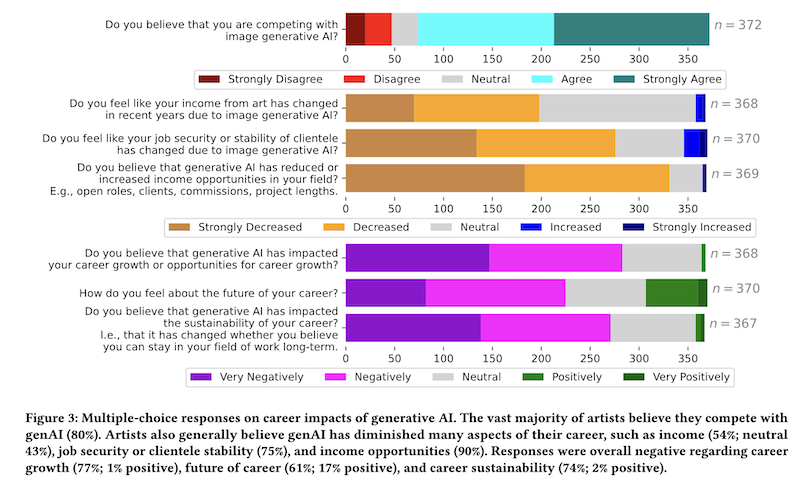
These technologies are attacking community-based projects, like Wikipedia, where even after banning LLM-generated content, volunteers have to carefully clean up the damage done.
Similarly, open source library maintainers have to wade through floods of bad submissions:
I’ve turned off pull requests from non-members for Flask, Werkzeug, Jinja, and Click this week, and have enjoyed not waking up to a fresh wave of AI junk every morning. I think I’m going to update our contributing guide to say “introduce yourself and how you use the library in chat first if you want to contribute pull requests”. Sad that we had to go here, but aside from conference sprints we weren’t really getting outside contribution anyway (which is also sad, but that’s been the case a lot longer than AI has been around). — David Lord (@davidism@mas.to) from Sep 18, 2026, 08:59 AM
The beginning of the month, when every junk producer’s token limit resets, and we get a whole new wave of junk. Turning off PRs helped a lot, but they just started opening “test issue, checking if my API access is broken”, or commenting or emailing their patches instead. I really wish I knew how to escape this without turning off community interaction entirely. — David Lord (@davidism@mas.to) from Oct 01, 2026, 09:35 AM:
These tools threaten the creation of knowledge in Mathematics by producing results without producing understanding. Declaration — Math and AI:
But solving problems is only a tool and proxy for achieving the primary goal of conceptual understanding and insight. Forgetting this in the world of AI may turn the tool against the primary goal. Indeed, the mass production at faster and faster pace of “true/false” statements could destroy fertile ground instead of breathing life into new ideas.
Centralization of authoritarian power
Like all technologies, “AI” is political. Its politics are authoritarian.
“AI” is a political project – I have also sometimes called it a narrative – whose purpose is the shifting of power and agency away from people and organizations towards centralized power structures. These centralized power structures are currently mostly a handful of big tech corporations and the “AI Labs” they keep shoveling money into.
“AI” as we use the term today is build on fascist ideas. Is structurally supportive of fascist thinking.
That does not mean that every user of “AI” products is therefore a fascist. Some “AI”-users might even consider themselves antifascists. But by using these systems you are integrating inherently fascist logic into your thinking, into your mental apparatus. These systems force you to at least accept the fascist tendencies within “AI” systems as “normal” or “okay”.
Effects on users
These technologies shape the mindsets of those who use them. They encourage their users to diminish their own cognitive capacities and damage public goods like universities.